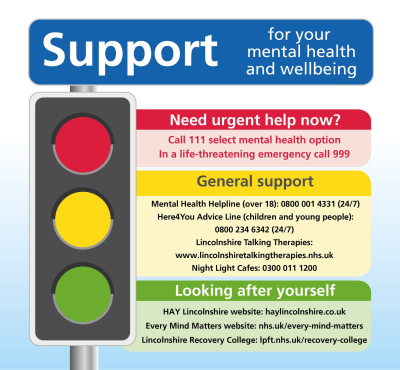
As well as your physical health, it is important to also consider your psychological health
After a Cardiac event, it is quite normal to experience changes to your mood. We would expect for most people these will lift within the first 4-6 weeks after a Cardiac event.
However, if mental health symptoms continue for longer than this, then there are tools you can use and services which you can be referred to in order to support your mental health and wellbeing. Lincolnshire Community Cardiology have close links with Lincolnshire Partnership Foundation Trust who are responsible for NHS Mental Health across Lincolnshire.
During your assessment with the Cardiac Rehab team, we offer basic psychological assessment and Quality of life assessment.
Psychological Wellbeing
1 in 4 people experience mental health problems at some point in their lives. It is important to understand and identify changes in our own wellbeing.
Altered thoughts.
Altered emotions.
Altered physical symptoms.
Altered behaviours.
If you are experiencing difficulties with any of the above, then please consider speaking to your Cardiac Rehabilitation team about this.
Looking after yourself
Take some time for self care – do things you enjoy
Do regular exercise
Eat a healthy diet
Make some time for rest/relaxation
Reach out to people
Refer to specialist services if needed
Self Help
There are various different techniques that can help people when they are feeling overwhelmed.
Grounding –
Grounding is a process whereby you count things around you and relate them to senses. This allows you to take a couple of minutes and possibly breaking a cycle of Anxiety or low mood.
Find 1 thing you can TASTE
Find 2 things you can SMELL
Find 3 things you can HEAR
Find 4 things you can TOUCH
Find 5 things you can SEE
Breathing –
There are a number of good breathing techniques which help when experiencing periods of difficult mental health.
Box square breathing is where you visualise a box and breathe in for four seconds (one second per side of a box) then breathe out for four seconds (one second per side of a box)
Diaphragmatic breathing is where you get yourself into a relaxed position and put one hand over your tummy. Try and move your tummy in and out when you breathe. You will feel your hand going up and down. This allows for a deeper breathing than you might usually do.
Guided mindfulness –
There are various apps, podcasts and youtube videos which may be able to support you in guided mindfulness. There are a lot to choose from and you have to find the right fit for you, so don’t be put off if it takes a while to find one you like.
Psychological medications and your heart
There are some medications which you may be taking for your mental health condition that need to be changed because of the impact this may have on your heart.
The Cardiologists in hospital will likely have identified this if it is required.
It may then be important to introduce an alternative medication to support your mental health.
NHS Talking Therapies
NHS talking therapies is a free confidential service who will support people with mild to moderate depression/anxiety disorders.
It offers professional support to help you understand what is going on after your Cardiac event and help to build coping strategies. The team will create an individually tailored treatment package for you. This service is also available to friends and family who may also require some support after your cardiac event.
There are various alternative support agencies out there who are able to provide mental health advice and support. Some of our team may suggest checking out apps like Headspace to help with relaxation and sleep aids. Click on the links below to find out more.
You can start a conversation via text with a trained volunteer for free confidential support.
If you're in immediate danger, Call emergency services on 999.
Other ways to get help, Call Samaritans on 116 123, Email Samaritans at jo@samaritans.org, Write to Samaritans, and Visit a local Samaritans branch.
For many, sexual activity is a big part of peoples lives, and so getting back to this is an important aspect of recovery.
However, people can find they approach this with apprehension and can be worried about the side effects or how this will now affect your heart. In fact, over 50% of people in a British heart foundation survey were worried about sex as a result of their cardiac condition.
The good news is, sex is no more likely to cause a cardiac issue than any other form of exercise. Most people consider returning to sexual activity around 2-4 weeks after a heart attack, and sometimes a bit longer after surgery due to wound healing.
If you are concerned about returning to sexual activity, consider taking a less energetic role initially.
Some patients can experience a side effect of impotence or lacking sexual desire as a result of some of the medications. If this is a concern to you, please raise it with a member of the team as we may be able to consider changes to medication regimes.
Most people after a heart condition are able to return to employment. People are able to return to work between 1-12 weeks depending on what diagnosis and treatment you have received and the job you do.
If you are currently unable to work and feel you need support with this, please discuss with your Cardiac Rehabilitation specialist.
Follow the advice given at hospital. If you are unsure when you can return to driving then please contact the Cardiac Rehabilitation team in your area. In general you are unable to drive for between 1-6 weeks depending on your diagnosis and treatment.
Group 2 licences (HGV/PCV) :
In general you must tell DVLA and stop driving if you’ve had a cardiac event. Fill in form VOCH1 and send it to DVLA (the address is on the form). If you need further advice please contact the Cardiac Rehabilitation team in your area.